How to Calculate Safe Working Load of a Crane?
The safe working load (SWL) of a crane is the maximum load it is permitted to lift in normal service. Knowing how to calculate and apply SWL protects your people, your equipment and your business from overload accidents and liability.
This guide explains what SWL means, the formula used for lifting gear, how to read the SWL for overhead and mobile cranes, how sling angles change the safe limit, and how often SWL must be tested and verified.
Quick answer: For ropes, chains and slings, SWL = minimum breaking load ÷ safety factor. For overhead and gantry cranes, SWL is the rated load stamped on the crane’s nameplate. For mobile cranes, the safe limit comes from the manufacturer’s load chart at your boom length, angle and radius.
What Is Safe Working Load (SWL)?
Safe working load (SWL) is the maximum mass that a crane, hoist or piece of lifting equipment is certified to lift safely under defined conditions. It is determined by the manufacturer through design calculations, testing and a built-in safety factor, and it is marked on the equipment.
SWL protects against:
- Structural failure of the crane, boom, girder or hook
- Wire rope, chain or sling breakage
- Tipping or loss of stability
- Premature wear that shortens crane life
SWL vs WLL vs Rated Capacity: What Is the Difference?
These terms are closely related and often mixed up:
| Term | Typically used for | Meaning |
|---|---|---|
| SWL (Safe Working Load) | Overhead cranes, hoists, older markings | Maximum load permitted in service |
| WLL (Working Load Limit) | Slings, shackles, chains, hooks | Maximum load the gear is designed to carry; the modern replacement for SWL on accessories |
| Rated capacity | Mobile and crawler cranes | Maximum load at a given configuration, taken from the load chart |
If your crane or lifting gear is marked with one of these values, that is the number you must not exceed, and it already includes a safety factor.
The SWL Formula for Ropes, Chains and Slings
There is no single universal formula that applies to every crane, but for wire rope, chain and slings the calculation is straightforward:
SWL (or WLL) = Minimum Breaking Load (MBL) ÷ Safety Factor (SF)
Typical safety factors (always confirm with the manufacturer and local regulation):
- Wire rope slings: commonly around 5:1
- Alloy chain slings (Grade 80 and above): commonly around 4:1
- Synthetic webbing and round slings: commonly around 7:1
Example: A wire rope has a minimum breaking load of 50,000 kg and a safety factor of 5:1.
SWL = 50,000 ÷ 5 = 10,000 kg
That 10,000 kg is the most you may lift with that rope in a straight vertical pull. You do not subtract another 10% on top, because the safety factor is already built in. Extra reductions are only applied when conditions require them, such as sling angle, wear or shock loading.
How Sling Angle Reduces SWL
When a load is lifted with two or more slings, the angle between the slings and the horizontal changes how much tension each leg carries. The smaller the angle, the higher the tension, so the usable SWL falls.
| Sling angle from horizontal | Approximate capacity factor |
|---|---|
| 90° (vertical) | 1.00 |
| 60° | 0.87 |
| 45° | 0.71 |
| 30° | 0.50 |
Example: A two-leg sling set has a combined vertical rating of 10,000 kg. At 45° from horizontal, the usable load is about 10,000 × 0.71 = 7,100 kg. Avoid angles below 45° whenever possible, and never go below 30°.
SWL of Overhead, Gantry and Mobile Cranes
Overhead (EOT) and gantry cranes
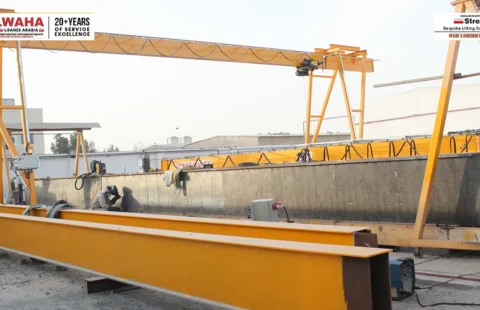
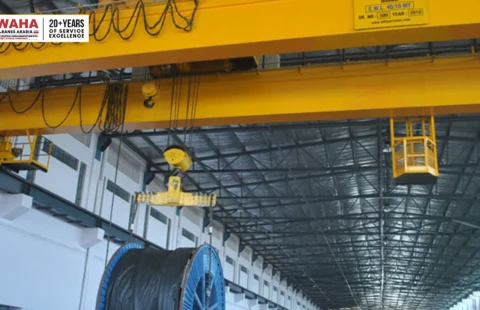
The SWL is the rated load shown on the crane’s nameplate. It covers the girder, trolley, hoist, hook and wire rope. You do not calculate it on site: you read it, respect it and never exceed it. Remember that attachments such as lifting beams, magnets and spreaders count as part of the load. See our overhead cranes and gantry cranes to compare available capacities.
Mobile, crawler and tower cranes
Capacity changes with every lift, so the safe limit comes from the manufacturer’s load chart, which depends on boom length, boom angle, working radius, counterweight and outrigger setup. Always use the gross load, which is the load plus rigging plus hook block. For a step-by-step method, read our guide on how to calculate crane capacity.
Factors That Reduce Safe Working Load in Practice
- Boom length and angle: longer boom or lower angle means lower capacity (mobile cranes)
- Load radius: the farther the load from the crane’s centre, the less you can lift
- Wind and weather: follow the maximum wind speed in the crane manual and stop lifts when it is exceeded
- Dynamic and shock loads: sudden starts, stops or swinging loads add force beyond the static weight
- Wear and damage: worn rope, corroded chain or deformed hooks must be removed from service or derated
- Ground and support: soft ground or poor outrigger support can cause tipping before the structural limit is reached
Worked Example: Combining Rigging and Crane Limits
An overhead crane has a nameplate SWL of 10,000 kg. You plan to lift a 9,200 kg press using a 400 kg spreader beam and 100 kg of shackles.
- Gross load: 9,200 + 400 + 100 = 9,700 kg
- Crane SWL: 10,000 kg
- Utilisation: 9,700 ÷ 10,000 = 97%
The lift is within the SWL, but it is very close to the limit. If the load weight is uncertain, if shock loading is likely or if your company policy sets a lower working limit, choose a higher-capacity crane or reduce the load. Use certified weighing equipment or manufacturer data to confirm the load weight, never an estimate.
Testing, Inspection and Compliance
SWL is not a one-time number. It must be supported by ongoing verification:
- Initial proof load test before first use, commonly at 110% to 125% of rated load depending on the standard and crane type
- Periodic thorough examination by a competent person, with intervals set by local regulation and usage
- Re-testing after major repairs, modifications or incidents
- Daily and pre-use checks of hooks, ropes, limit switches and controls
- Legible SWL markings that must never be covered, removed or altered
Relevant frameworks include OSHA, ISO, LOLER and regional requirements in the UAE and KSA. Always follow the stricter rule. Al Waha Cranes provides crane safety inspections and certifications and maintenance and repair services to keep your SWL valid and your lifts compliant.
SWL Safety Checklist
- Read the SWL or WLL marking on the crane and every item of lifting gear
- Calculate the gross load, including rigging and hook block
- Check the sling angle and apply the correct reduction factor
- Use the load chart for mobile cranes at the real radius and configuration
- Inspect gear for damage and confirm certification is in date
- Never use a crane or sling with unreadable or missing SWL markings
- Use trained riggers, signallers and operators
Frequently Asked Questions
1. What is the safe working load of a crane?
Answer: It is the maximum load the crane is certified to lift safely in service. For overhead cranes it is on the nameplate, and for mobile cranes it comes from the load chart for the specific configuration.
2. How do you calculate SWL?
Answer: For ropes, chains and slings, divide the minimum breaking load by the safety factor. For cranes themselves, use the manufacturer’s rated load or load chart rather than calculating from scratch.
3. What is the difference between SWL and WLL?
Answer: They mean nearly the same thing. WLL (working load limit) is the preferred modern term for lifting accessories, while SWL is still widely used for cranes and older equipment.
4. Can I lift more than the SWL if the crane seems strong enough?
Answer: No. SWL is a certified limit. Exceeding it voids safety margins, can breach regulations and risks serious injury and equipment failure.
5. Should I reduce SWL by 10 to 15% for safety?
Answer: SWL already contains a safety factor, so you do not automatically deduct more. You may need to derate for wear, shock loads, sling angle, wind or site rules, so follow the manufacturer and your lift plan.
6. How often should crane SWL be tested?
Answer: Testing after installation, major repair or modification is standard, with periodic thorough examinations at intervals set by regulation, commonly every 6 to 12 months depending on the equipment and local law.
Keep Every Lift Within Its Safe Working Load
Understanding SWL, using the right formula for ropes and slings, reading nameplates and load charts correctly, and keeping inspections up to date are the foundations of safe lifting.
Al Waha Cranes is the UAE’s largest stockist of STREET cranes, supplying EOT cranes, gantry cranes, jib cranes, monorail cranes and hoists, backed by installation, inspection and maintenance across the UAE and KSA. Contact our team for help choosing the right crane capacity or verifying your current SWL, or request a quote today.
Disclaimer: This article is general guidance. Always follow the manufacturer’s manual, load charts, applicable regulations and the advice of a qualified lift planner or appointed person.