Remote-Controlled Cranes vs Manual Cranes
Choosing the right crane system is a major decision for construction companies, factories, warehouses, oil & gas facilities, and infrastructure developers across the UAE and Saudi Arabia. Whether you operate in the fast-growing skyline of Dubai, the mega-project zones of Riyadh, the industrial hubs of Jeddah, or energy facilities in Abu Dhabi, selecting between remote-controlled cranes and manual (cab-operated) cranes impacts safety, efficiency, compliance, and long-term cost.
What Is a Crane?
A crane is a machine used to lift, move, and position heavy materials. In the Gulf region, cranes are essential for the following:
- High-rise construction
- Oil & gas projects
- Ports and shipping
- Warehouses
- Manufacturing plants
- Infrastructure projects (metro, bridges, stadiums)
Cranes come in many types—tower cranes, overhead cranes, gantry cranes, and mobile cranes—but today we are focusing on how they are controlled.
- Remote-Controlled
- Manual (Cab-Operated)
What Are Remote-Controlled Cranes?
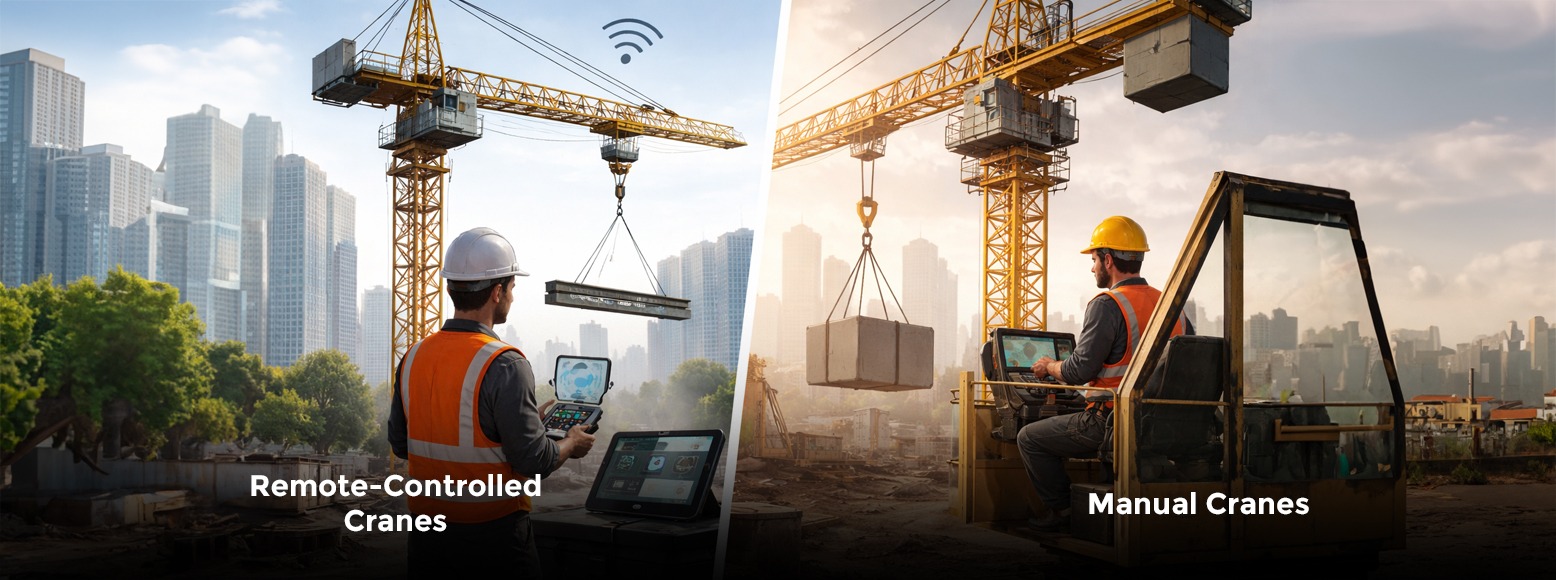
A remote-controlled crane is operated using a wireless or wired handheld transmitter. The operator stands on the ground and controls movement remotely.
How It Works:
- The operator holds a control unit (like a large industrial remote)
- Crane responds wirelessly
- The operator can walk around for better visibility
Common in UAE & KSA:
- Warehouses in JAFZA
- Manufacturing plants in Riyadh Industrial City
- Steel fabrication facilities
- Automotive assembly lines
- Logistics hubs
Main Advantage:
Operators do not sit in a high cabin—they can position themselves safely on the ground.
What Are Manual (Cab-Operated) Cranes?
A manual crane has an operator sitting inside a cab attached to the crane structure.
How It Works:
- The operator climbs into the cabin
- Uses joysticks, pedals, and levers
- Controls movement directly from an elevated position
Common in UAE & KSA:
- Tower cranes in the Dubai skyline
- Mega-projects in the NEOM region
- Oil & gas facilities
- Shipyards
- Large infrastructure projects
Manual cranes are often used when lifting extremely heavy loads outdoors.
Key Differences
| Feature | Remote-Controlled | Manual (Cab-Operated) |
| Operator Location | Ground | Elevated cab |
| Visibility | Flexible (walk around) | Fixed position |
| Safety Exposure | Lower | Higher |
| Best Environment | Indoor/industrial | Outdoor/mega-projects |
| Installation Cost | Moderate | Higher |
| Maintenance | Electronics-based | Mechanical and cab systems |
Safety Comparison
Safety regulations in both the UAE and KSA are strict—especially for government and oil-sector projects.
Remote-Controlled Cranes—Safety Benefits
✔ The operator stays away from suspended loads
✔ Better angle visibility
✔ Reduced fall risk
✔ No cabin climbing
✔ Ideal for high-temperature environments
This is especially useful in desert climates where the heat can exceed 45°C.
Manual Cranes—Safety Considerations
✔ Direct mechanical feel
✔ Less signal dependency
However:
- Operator exposed to height
- Limited movement inside the cabin
- Risk during sandstorms or extreme heat
In cities like Riyadh, where summer temperatures are extreme, remote systems reduce heat exposure significantly.
Cost Comparison: Initial vs Long-Term Investment
Many companies focus only on upfront cost, but smart buyers calculate the total cost of ownership.
Remote-Controlled Crane Costs
Initial:
- Controller system
- Receiver installation
- Industrial batteries
Long-Term:
✔ Lower insurance risk
✔ Reduced injury costs
✔ Faster operations
✔ Lower downtime
Manual Crane Costs
Initial:
- Cabin installation
- Structural integration
- Access ladders & safety systems
Long-Term:
- Cabin maintenance
- Operator fatigue
- Potential for higher insurance premiums
Climate & Environmental Considerations
The Gulf climate is unique.
Extreme Heat
Electronics must be rated for:
- 50°C+ operation
- Dust-resistant (IP-rated systems)
Sand & Dust
Manual cabin systems can accumulate dust.
Remote systems must use sealed transmitters.
Coastal Humidity (e.g., Jeddah)
Corrosion resistance is essential.
Industry-Specific Recommendations
Construction (High-Rise Towers)
In places like Dubai:
Best Choice → Manual tower cranes
Reason → Height, heavy loads, constant elevation work
Manufacturing & Warehousing
Best Choice → Remote-Controlled cranes
Reason → Indoor environment, repetitive lifting, and flexibility
Oil & Gas (Abu Dhabi, Eastern Province)
Hybrid approach recommended:
- Manual for heavy outdoor lifts
- Remote for plant-level operations
Ports & Logistics
Increasing shift toward semi-remote automation.
Productivity & ROI Impact
Remote cranes often
- Reduce load positioning time
- Improve precision
- Minimize communication errors
- Increase throughput
Manual cranes:
- Strong for continuous heavy lifting
- Reliable for mega-structures
Return on investment depends on:
- Volume of lifts per day
- Labor costs
- Safety incidents
- Downtime frequency
Technology Trends in UAE & Saudi Arabia
Large projects—including those that shaped iconic structures like the Burj Khalifa—demonstrate how crane technology continues to evolve.
Current trends include:
- Anti-collision systems
- Load monitoring sensors
- Remote diagnostics
- Smart fleet management
- Semi-automation
- AI-assisted lifting
Saudi Vision 2030 projects are increasingly adopting advanced crane control systems.
Compliance & Regulations Overview
Both the UAE and Saudi Arabia require the following:
- Certified crane operators
- Regular inspections
- Load testing
- Safety documentation
- Preventive maintenance logs
Remote systems must comply with:
- Industrial radio frequency standards
- Electrical safety certifications
Always check:
- SASO standards (KSA)
- UAE municipal authority approvals
When Should You Upgrade to Remote Control?
Consider upgrading if:
- Operators report visibility issues
- You experience frequent safety near-misses.
- Your warehouse layout changed
- Productivity is below target
- You want to reduce operator fatigue
- Insurance premiums increased
Many UAE industrial facilities are retrofitting overhead cranes with remote kits.
Common Mistakes Buyers Make
- Choosing based only on price
- Ignoring environmental conditions
- Not checking the IP protection rating
- Underestimating operator training
- Buying non-certified remote systems
- Not planning for spare parts availability in GCC
Frequently Asked Questions
1. Are remote-controlled cranes safe in extreme UAE heat?
Yes—if you choose industrial-grade transmitters rated for high temperatures and dust protection.
2. Do remote cranes work during sandstorms?
They can, but visibility and site safety policies must always be followed. The electronic system itself must be IP-rated.
3. Are manual cranes more powerful?
Not necessarily. Power depends on crane design, not control type.
4. Which is better for warehouses in Riyadh?
Remote-controlled cranes are usually better for indoor warehousing operations.
5. Is training required for remote cranes?
Yes. Operators must be trained and certified according to local regulations.
6. Are remote cranes more expensive?
Initial costs may be moderate, but long-term savings often make them more cost-effective.
7. Can manual cranes be converted to remote control?
In many cases, yes—especially overhead industrial cranes.
8. Which is better for mega-projects like NEOM?
Large outdoor lifting still relies heavily on manual or hybrid systems.
Quick Decision Table
| If You Are… | Choose This | Why |
| Running a warehouse | Remote-Controlled | Better mobility & safety |
| Managing a factory | Remote-Controlled | Faster repetitive lifting |
| Building skyscrapers | Manual | High-elevation operation |
| Working in oil & gas | Hybrid | Heavy + precision needs |
| Focused on reducing injuries | Remote | The operator stays on the ground. |
| Handling extremely heavy outdoor loads | Manual | Stable elevated control |
Final Thoughts
There is no “one-size-fits-all” answer.
Remote-controlled cranes are ideal for:
- Indoor operations
- Safety-focused environments
- Efficiency-driven industries
Manual cranes are ideal for:
- Mega outdoor construction
- Heavy structural lifting
- High-elevation operations
For many GCC companies, the smartest strategy is a hybrid approach—using each system where it performs best.