When Should You Use a Jib Crane in a Factory?
If you run or manage a factory in the UAE or Saudi Arabia, you already know how important safe and efficient material handling is. Whether you operate in Dubai’s industrial zones, Abu Dhabi’s manufacturing hubs, Sharjah’s workshops, Riyadh’s factories, or Jeddah’s logistics centers, lifting heavy materials is part of daily operations.
One common question factory owners and plant managers ask is
“When should I use a jib crane instead of forklifts or overhead cranes?”
What Is a Jib Crane?
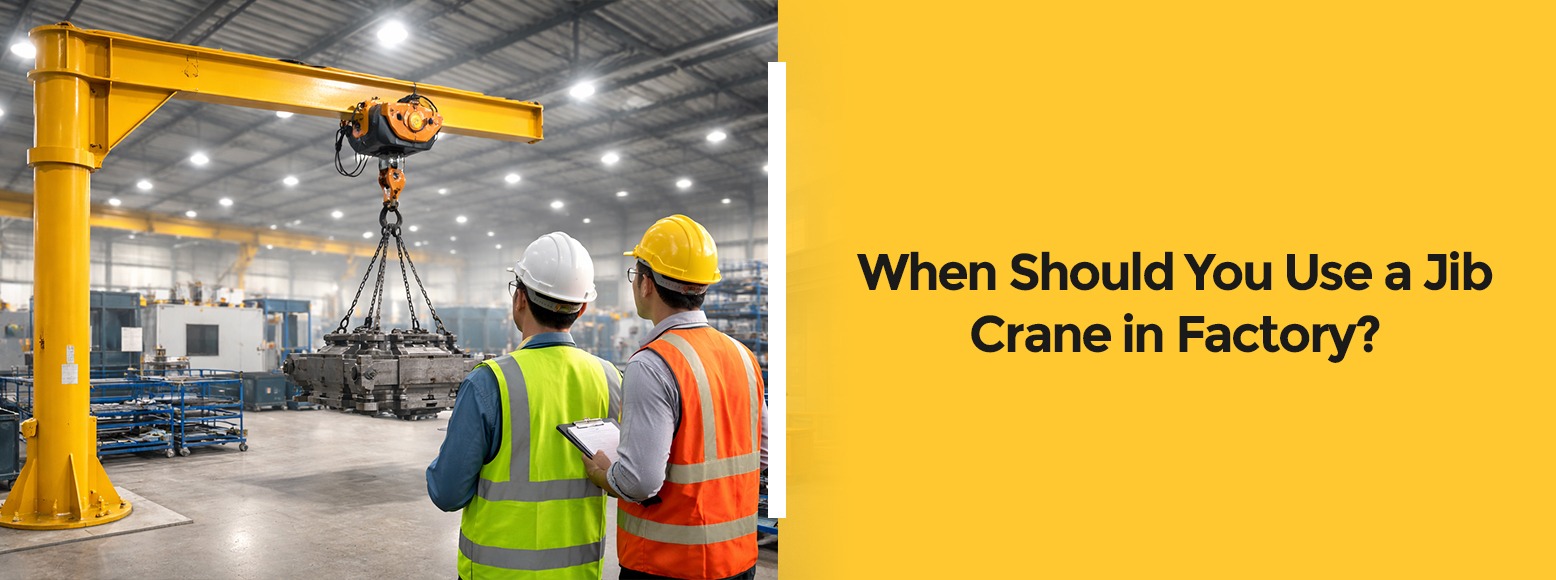
A jib crane is a type of crane with a horizontal arm (called a jib or boom) that supports a hoist. The arm rotates around a fixed support (column or wall), allowing operators to lift and move materials within a defined circular area.
Unlike large overhead cranes that cover an entire factory bay, jib cranes are designed for localized lifting at a specific workstation.
Main Components:
- Vertical column or wall bracket
- Horizontal boom (jib arm)
- Hoist (electric or manual)
- Trolley system
- Rotation mechanism (180° to 360°)
Why Jib Cranes Are Popular in UAE & KSA Factories
Industries in the Gulf region often face:
- Heavy steel fabrication
- Oil & gas component handling
- Aluminum and glass manufacturing
- HVAC production
- Warehousing and logistics
- Food processing plants
- Automotive workshops
Many factories operate in high-temperature environments and fast-paced production settings. A jib crane offers:
✔ Faster loading/unloading
✔ Reduced forklift traffic
✔ Improved worker safety
✔ Lower operational cost compared to bridge cranes
Use a jib crane for repetitive workstation lifting.
If your factory has workers repeatedly lifting materials at the same station, a jib crane is ideal.
Example:
- Loading metal sheets into a CNC machine
- Moving molds in injection molding
- Handling pumps or valves in oilfield workshops
- Lifting compressors in the HVAC assembly
Instead of waiting for a forklift every time, operators can lift and position loads independently.
Why It Matters in UAE/KSA:
Labor costs, safety compliance, and productivity targets are increasing. Repetitive manual lifting leads to injuries and lost productivity.
When Forklifts Are Causing Bottlenecks
Many factories rely heavily on forklifts.
But forklifts
- Take up floor space
- Require operators
- Create traffic congestion
- Increase accident risk
In busy industrial areas like JAFZA (Dubai) or Second Industrial City (Riyadh), floor space is expensive. A jib crane eliminates the need for constant forklift movement in small areas.
Use a jib crane when:
- Forklifts are frequently loading the same machine
- A forklift waits in the queue
- Operators depend on drivers for small lifts
When You Don’t Need Full-Building Coverage
If you don’t need a crane across the entire warehouse, installing a full overhead crane system may be unnecessary and expensive.
For example:
- Small steel workshops
- Maintenance bays
- Fabrication shops
- Assembly lines
A jib crane gives localized lifting without major structural changes.
When Worker Safety Is a Priority
Workplace safety regulations in the UAE and Saudi Arabia are becoming stricter.
In Saudi Arabia, regulatory oversight is guided by the Saudi Standards, Metrology, and Quality Organization.
In the UAE, occupational safety policies are influenced by bodies such as the Ministry of Human Resources and Emiratization.
Manual lifting injuries can lead to:
- Back injuries
- Shoulder strain
- Workers’ compensation claims
- Production downtime
A jib crane:
- Reduces physical strain
- Improves load control
- Minimizes sudden drops
- Increases precision placement
Ideal Load Conditions for Jib Cranes
Jib cranes work best when:
| Condition | Ideal Range |
| Load capacity | 250 kg – 5 tons |
| Movement area | Circular (180°–360°) |
| Travel distance | Short-range |
| Frequency | High repetition |
If your factory regularly lifts 10–20 tons across large distances, a bridge crane is more suitable.
When Ceiling Height Is Limited
Many factories in the UAE’s industrial areas have mid-height ceilings (6–9 meters). Installing a full overhead crane may reduce headroom significantly.
A wall-mounted or column-mounted jib crane:
- Uses less vertical space
- Requires minimal structural modification
- Can be installed in tight workshops
When You Want a Cost-Effective Solution
Compared to overhead cranes, jib cranes:
- It costs less to install
- Require less steel structure
- Have lower maintenance
- Consume less power
For small to mid-sized factories in Sharjah, Dammam, or Al Quoz, this makes financial sense.
Types of Jib Cranes
1. Free-Standing (Pillar Mounted)
- Mounted on a floor foundation
- 360° rotation
- Ideal for heavy-duty use
2. Wall-Mounted
- Attached to an existing structural column
- 180°–200° rotation
- Saves floor space
3. Articulating Jib Crane
- Has two arms
- Moves around obstacles
- Perfect for tight assembly areas
When NOT to Use a Jib Crane
Avoid using one if:
❌ You need long, linear movement
❌ Loads exceed structural capacity
❌ You need multi-bay coverage
❌ Floor foundation cannot support column loads
In those cases, consider:
- Overhead bridge crane
- Gantry crane
- Monorail system
Key Considerations for UAE & KSA Installation
Before installing a jib crane, consider:
- Foundation Strength
Free-standing models require proper concrete foundations.
- Wind Load (Outdoor Use)
Outdoor cranes in Saudi Arabia must consider desert wind conditions.
- Power Supply
Ensure correct voltage compatibility (often 380–415V in GCC).
- Heat Resistance
High temperatures (45–50°C) require suitable motor and hoist ratings.
- Compliance & Certification
Make sure equipment complies with local standards and inspections.
Industries in UAE & KSA That Benefit Most
- Steel fabrication
- Oil & gas workshops
- Marine maintenance
- Construction material factories
- Aluminum & glass processing
- Logistics & packaging plants
- Automotive service centers
- Food manufacturing units
How a Jib Crane Improves Productivity
Here’s what typically improves after installation:
✔ Reduced machine idle time
✔ Faster loading/unloading
✔ Lower forklift dependency
✔ Better material flow
✔ Improved worker morale
Factories often see ROI within 6–18 months, depending on usage frequency.
Frequently Asked Questions
- What is the typical cost of a jib crane in the UAE or KSA?
Prices vary based on capacity and span. Smaller models may start from mid-range industrial pricing, while heavy-duty units cost more depending on hoist type and installation.
- Can a jib crane be installed in an existing factory?
Yes. Most are retrofitted into existing structures with proper structural assessment.
- How much weight can a jib crane lift?
Typically between 250 kg and 5 tons. Heavy-duty custom versions may handle more.
- Does it require special training?
Yes. Operators should receive basic lifting safety training according to local safety standards.
- How long does installation take?
Usually 1–3 days, depending on foundation work and electrical setup.
- Is maintenance expensive?
No. Jib cranes have relatively low maintenance compared to bridge cranes.
- Can it be used outdoors in Saudi Arabia?
Yes, but it must be designed for high wind loads and extreme temperatures.
- What is the lifespan of a jib crane?
With proper maintenance, 15–25 years or more.
Quick Decision Table—Should You Use a Jib Crane?
| Situation | Use a jib crane? | Reason |
| Repetitive lifting at one workstation | YES | Ideal for localized lifting |
| Need full warehouse coverage | NO | Use an overhead crane |
| Limited floor space | YES | Wall-mounted option available |
| Heavy loads above 10 tons | NO | Bridge crane better |
| Forklift congestion | YES | Reduces traffic |
| Budget constraints | YES | Lower cost than bridge systems |
| Long-distance material travel | NO | Not designed for that |
| High safety concerns from manual lifting | YES | Reduces injury risk |
Final Thoughts
If your factory is in the UAE or Saudi Arabia:
- Has repetitive lifting tasks
- Experiences forklift congestion
- Wants to improve safety
- Needs a cost-effective lifting solution
- Doesn’t require full-building crane coverage
Then a jib crane is likely the right choice.
It’s practical, affordable, and highly effective for workstation-based material handling.