Complete Guide to Choosing the Right Industrial Crane for Your Factory
If you run or manage a factory in the UAE or Saudi Arabia (KSA), choosing the right industrial crane is not just about lifting heavy materials—it’s about safety, compliance, productivity, and long-term cost efficiency.
Whether you operate in Dubai, Abu Dhabi, Sharjah, Riyadh, Jeddah, Dammam, or Jubail, industrial lifting equipment plays a critical role in sectors like
- Construction materials
- Oil & gas
- Steel fabrication
- Automotive workshops
- Logistics & warehousing
- Manufacturing plants
- Ports & marine industries
Why Choosing the Right Crane Matters in the UAE & KSA
Industrial environments in the Gulf region are unique. High temperatures, dust, coastal humidity, and heavy industrial workloads demand durable and compliant equipment.
A wrong crane choice can lead to
- Downtime and production delays
- Increased maintenance costs
- Safety violations
- Failed inspections
- Structural damage
- Legal penalties
A properly selected crane increases the following:
- Operational efficiency
- Worker safety
- Load handling accuracy
- Long-term ROI
- Equipment lifespan
Step 1: Understand Your Lifting Requirements
Before contacting a supplier, clearly define your needs.
1. Maximum Load Capacity
Ask yourself:
- What is the heaviest load I will lift?
- Is lifting occasional or frequent?
- Will the load weight increase in the future?
Golden Rule:
Choose a crane with 20–30% higher capacity than your maximum expected load.
For example:
- If your heaviest load is 5 tons, choose a 6–7 ton rated crane.
This prevents strain and increases lifespan.
2. Lifting Height
Measure:
- Floor-to-ceiling height
- Hook approach distance
- Clearance requirements
In UAE & KSA factories, clear heights typically range between the following:
- 6–12 meters (small workshops)
- 12–25 meters (large industrial sheds)
The crane must provide sufficient lifting height without compromising safety.
3. Span Length
Span refers to the distance between runway beams.
Typical spans:
- Small workshops: 6–15 meters
- Industrial plants: 15–30 meters
- Large manufacturing: 30+ meters
4. Duty Cycle (How Often You Lift)
Cranes are classified by usage intensity:
- Light duty—occasional lifting
- Medium duty—Regular daily use
- Heavy duty – Continuous operation (steel plants, fabrication, oil & gas)
If you choose a light-duty crane for heavy-duty operations, breakdowns are inevitable.
Step 2: Types of Industrial Cranes
Let’s explore the most common crane types used in the UAE & KSA industries.
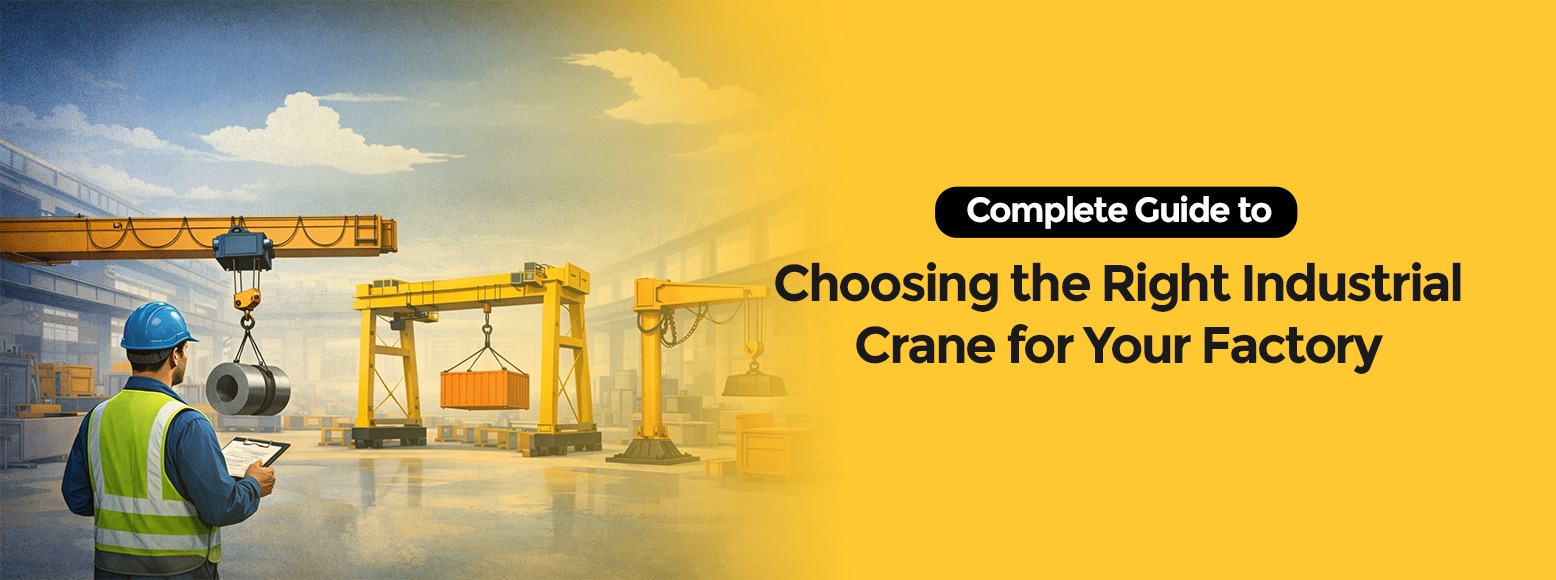
1. Overhead (Bridge) Cranes
Best for:
- Large factories
- Steel fabrication plants
- Manufacturing units
Overhead cranes run on runway beams attached to the building structure.
Types:
- Single girder
- Double girder
Advantages:
- Handles heavy loads (1 ton to 100+ tons)
- Covers large areas
- Ideal for repetitive lifting
Ideal for:
- Dubai industrial zones
- Jubail Heavy Industries
- Dammam manufacturing plants
2. Gantry Cranes
Gantry cranes are supported by legs and run on ground rails.
Best for:
- Outdoor yards
- Ports
- Precast yards
- Construction sites
Advantages:
- No need for building a support structure
- Can be mobile
- Great for large outdoor lifting
Popular in:
- Saudi construction sites
- UAE marine and shipping yards
3. Jib Cranes
Small, cost-effective cranes mounted on:
- Walls
- Columns
- Floor pillars
Best for:
- Workshops
- Assembly lines
- Maintenance bays
Advantages:
- Affordable
- Space-saving
- Ideal for localized lifting
4. Monorail Cranes
Used for linear movement along a single beam.
Best for:
- Production lines
- Warehouses
- Assembly stations
5. Portal Cranes
Large outdoor cranes are used for:
- Ports
- Heavy industrial yards
- Oil & gas facilities
Step 3: Environmental Considerations
High Temperature Resistance
UAE and KSA summer temperatures exceed 45°C.
Ensure:
- Motors are heat-resistant.
- Electrical panels have cooling systems
- Insulation is rated for extreme temperatures
Corrosion Protection
Coastal cities like:
- Jeddah
- Dammam
- Dubai
Require:
- Galvanized components
- Anti-corrosion paint
- Marine-grade steel
- IP-rated electrical panels
Dust & Sand Protection
Industrial zones experience sandstorms.
Ensure:
- Sealed electrical components
- High IP rating (IP55 or higher)
- Dust-resistant motor enclosures
Step 4: Compliance & Regulations in UAE & KSA
Industrial cranes must comply with the following:
In UAE
- Dubai Municipality regulations
- Abu Dhabi OSHAD standards
- Emirates Authority for Standardization (ESMA)
- Civil Defense approval
In Saudi Arabia
- Saudi Aramco standards (if applicable)
- SABER certification
- Saudi Building Code
- Ministry of Industry regulations
Never purchase cranes without proper certification.
Step 5: Choosing the Right Hoist
The hoist is the lifting mechanism.
Wire Rope Hoist
Best for:
- Heavy loads
- High lifting height
- Smooth operation
Chain Hoist
Best for:
- Lighter loads
- Budget applications
- Compact spaces
Step 6: Safety Features You Must Not Ignore
Mandatory features:
- Overload protection
- Emergency stop
- Limit switches
- Anti-collision systems
- Warning alarms
- Load display indicator
- Proper grounding
In oil & gas environments, explosion-proof cranes are required.
Step 7: Installation Considerations
Before installation:
- Conduct structural analysis
- Verify building load capacity
- Ensure proper foundation
- Check runway alignment
- Plan power supply
Retrofitting old buildings often requires reinforcement.
Step 8: Maintenance Planning
In Gulf climates, maintenance is critical.
Plan for:
- Monthly inspection
- Annual load testing
- Lubrication schedule
- Brake inspection
- Wire rope check
- Electrical system review
Preventive maintenance reduces downtime significantly.
Step 9: Budget Planning
Consider:
- Crane purchase cost
- Installation cost
- Civil modifications
- Electrical setup
- Annual maintenance
- Operator training
- Spare parts
Cheap cranes often cost more in the long term.
Step 10: Common Mistakes to Avoid
- Underestimating load capacity
- Ignoring future expansion
- Buying non-certified equipment
- Skipping structural analysis
- Ignoring environmental factors
- Not training operators
8 Frequently Asked Questions (FAQs)
1. What is the best crane type for a factory in the UAE?
For indoor manufacturing, an overhead crane is usually best. For outdoor yards, gantry cranes are ideal.
2. How much does an industrial crane cost in the UAE or KSA?
Costs vary. widely:
- Jib crane: lower cost
- Overhead crane: medium to high
- Heavy gantry crane: high investment
Prices depend on capacity, span, and customization.
3. How often should cranes be inspected?
Monthly visual checks and annual full inspections are recommended.
4. Can old factory buildings support overhead cranes?
Not always. A structural engineer must evaluate load-bearing capacity.
5. What safety certifications are required in Saudi Arabia?
Compliance with the Saudi Building Code, SABER, and relevant ministry approvals is required.
6. What crane capacity do I need for a 5-ton load?
Choose at least a 6–7 ton rated crane to allow a safety margin.
7. Are explosion-proof cranes required in the oil & gas industries?
Yes, especially in hazardous classified zones.
8. How long does installation take?
Small cranes: 1–2 weeks
Large systems: 3–6 weeks, depending on complexity.
Quick Decision Table
| Factory Needs | Recommended Crane Type | Why |
| Small workshop lifting under 3 tons | Jib Crane | Cost-effective & compact |
| Large indoor factory | Overhead Crane | Covers wide area efficiently |
| Outdoor construction yard | Gantry Crane | No building support required |
| Assembly line transport | Monorail Crane | Linear movement |
| Heavy industrial plant (20+ tons) | Double Girder Overhead | High capacity & durability |
| Oil & Gas zone | Explosion-Proof Crane | Safety compliance |
Final Thoughts
Choosing the right industrial crane in the UAE & KSA is about
- Understanding your operational needs
- Planning for environmental conditions
- Ensuring regulatory compliance
- Investing in safety
- Thinking long-term
The right crane improves productivity, safety, and cost efficiency for years.
If you are planning a crane installation in the UAE or Saudi Arabia, evaluate your lifting requirements carefully and consult certified professionals before making a final decision.
A well-chosen crane is not an expense—it’s a long-term investment in operational excellence.